Planning a European golden visa in the next 12–24 months?
Know which golden visa is worth your €250K–€500K. In one evening.
Six programmes are still open. This guide gives you the real cost of each, the tax regime that fits you, and one honest verdict per country. From an operator who runs the funds these programmes invest in, and takes no placement fee.
- Skip weeks of research and the first €10,000 of adviser time.
- All six, side by side, with the costs the brochures leave out.
- Walk into your next adviser call knowing what a weak answer looks like.
Regular price $79 Launch offer, $49, with the bonuses below
Dr. Alessandro Palombo·€29M+ allocated·150+ visas assisted·365-day guarantee
Instant access. Web + PDF. Yours for good, updated as the rules change.
It’s not you. The market is built this way.
You asked one question: which programme? Now you have two advisers, two answers, and less certainty than when you started. Here’s why.
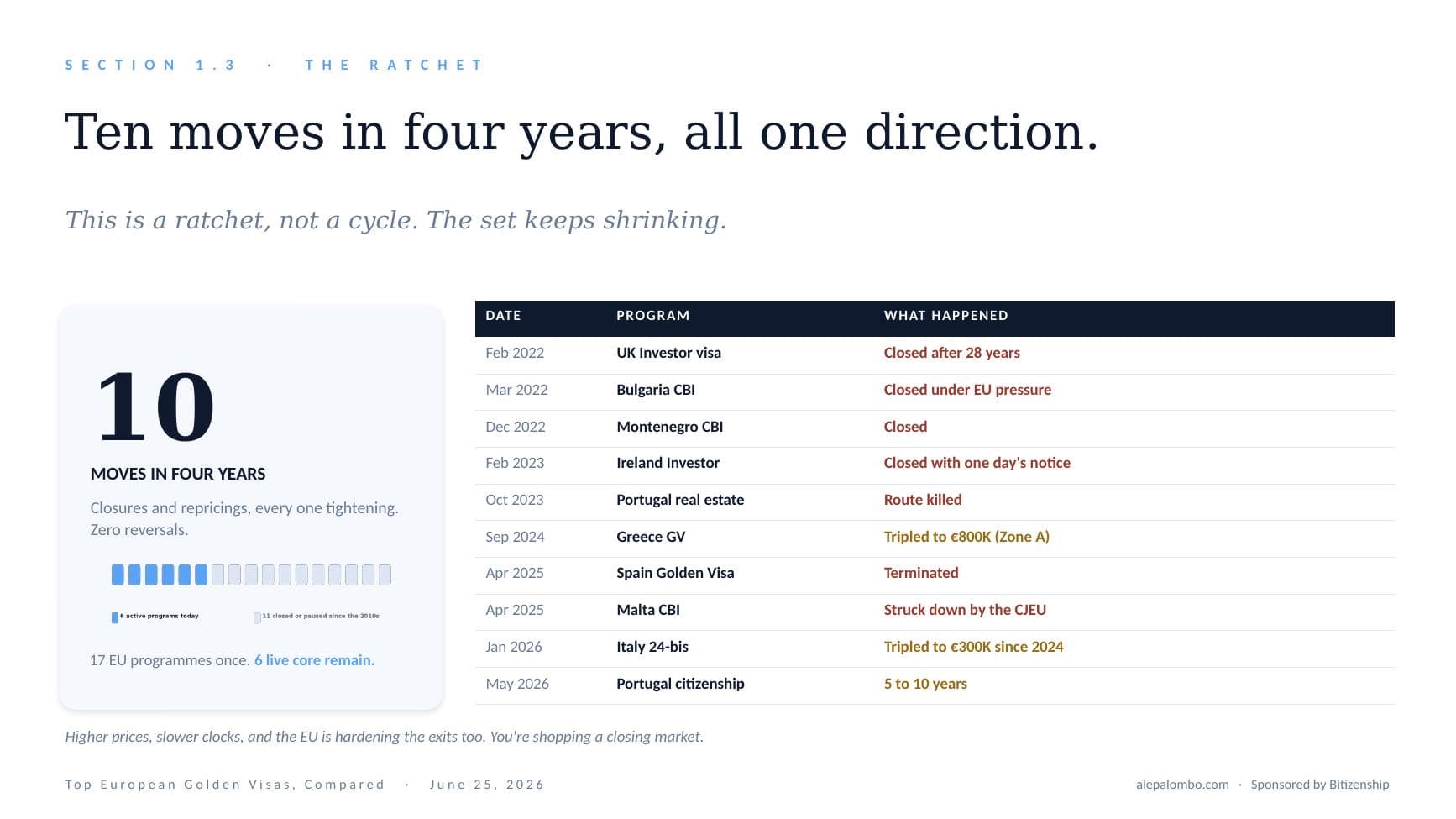
- Programmes keep changing. Seventeen once. Six left. Zero reversals. Portugal doubled its citizenship clock; Italy tripled its flat tax in eighteen months.
- Every one is full of nuance. Presence rules, family rules, when the tax regime actually applies. The headline number tells you nothing.
- Who do you trust? The typical adviser is paid when your capital is placed. That rewards fear of the programme you hold and conviction about the one you don’t.
- Good advisers have blind spots. A Portugal specialist isn’t current on Italy. A local lawyer isn’t thinking about your US return.
- There is no winner. No wrong programme, only the wrong fit. It depends on your wealth, income, family, presence, and horizon.
- It’s never just the investment. ~10% in fees on top. 5–15% inside the vehicle. 20–30% in off-plan property. Then the queue: 12–16 months in Greece.
You don’t need another opinion. You need a way to grade the ones you have.
Three filters. Four tests. Two costs. One verdict per programme.
The frame
A golden visa is an option on residency, not a tax product. Why the market only tightens. The €3,000 descent check to run before the €250,000 one. The method I use before recommending anything.
The six
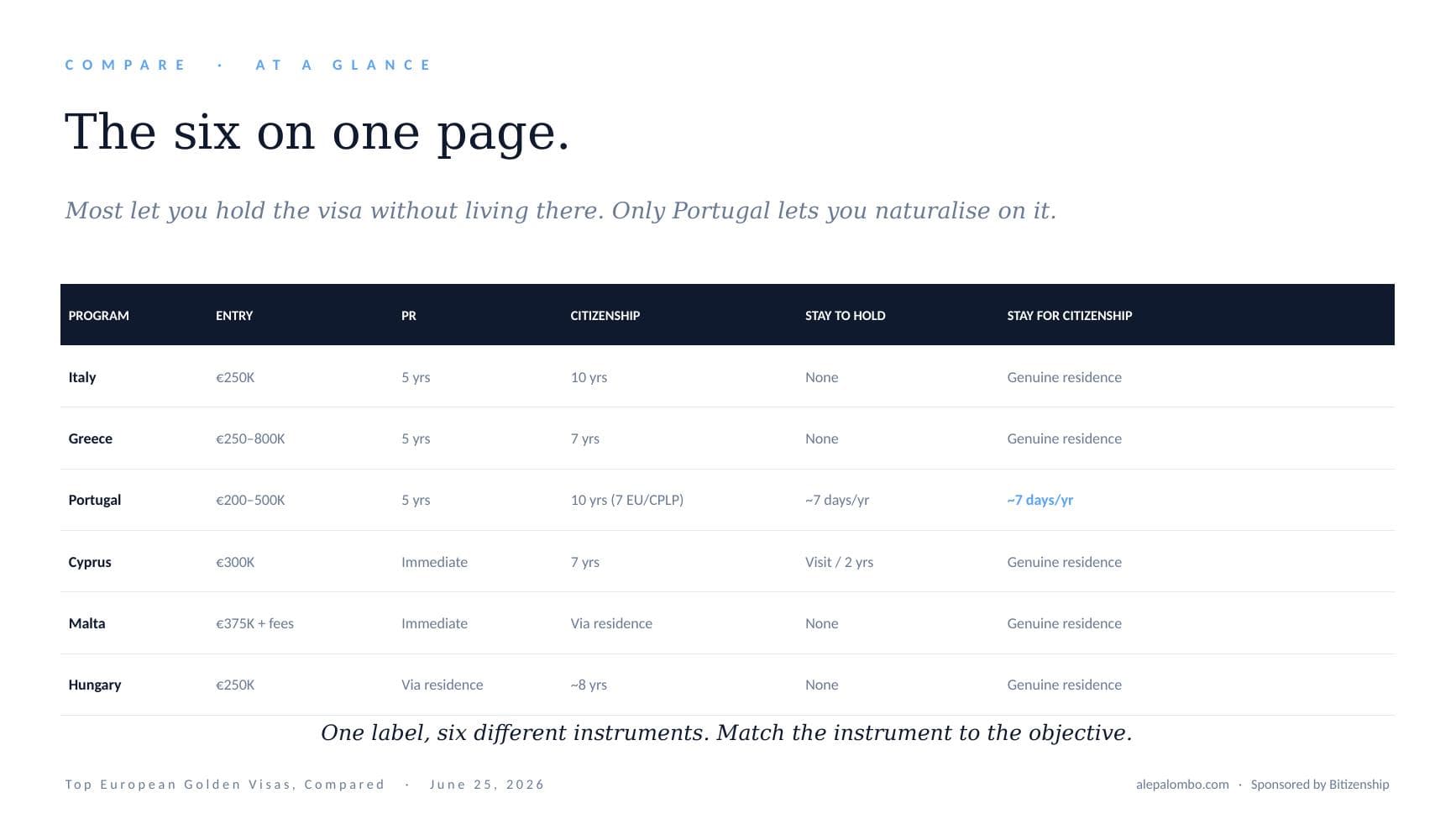
Italy, Greece, Portugal, Hungary, Malta, Cyprus. Routes, real costs, tax, timelines, family, and a verdict with the conditions that would change it.
Your decision
Five inputs. Three buyer profiles. Four tests before you sign. The red flags that end a conversation.
You’ll learn
- Why the lowest advertised investment is rarely the lowest cost, and the two numbers to demand in writing
- The only programme that still builds toward a passport without you moving, and the year your capital comes back
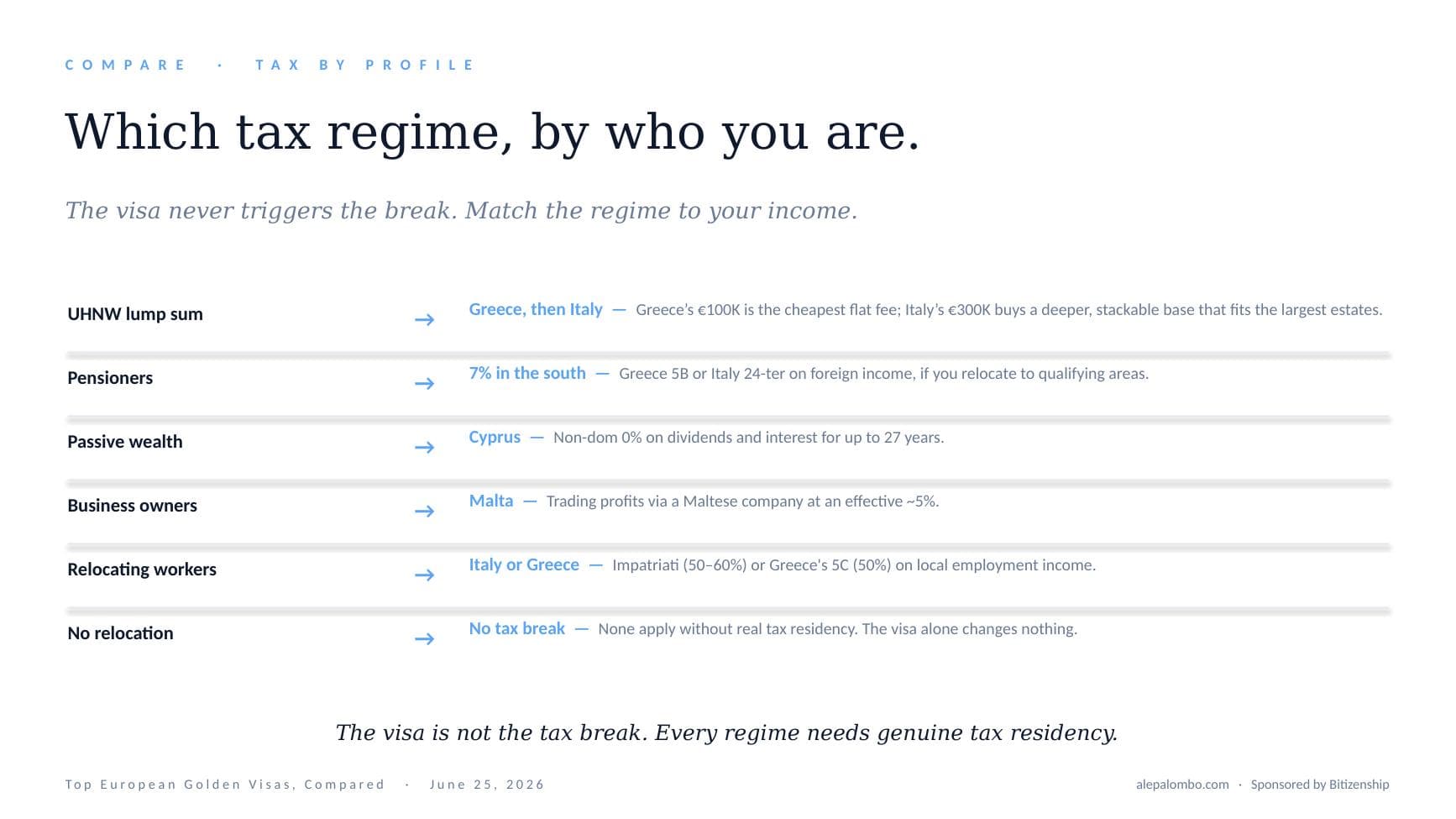
- Why the visa never triggers the tax break, and the income below which a flat tax costs you money
- What a US filer must check before subscribing to any European fund
- The four tests and the red flags that end a conversation
- Why fewer than 8% ever use the option, and why the other 92% still bought the right thing
- When the honest answer is: do nothing yet
Three questions before you spend €250,000
- For your top programme, do you know the all-in cost over five years, including what’s inside the vehicle?
- Do you know how many days a year the residency needs, and how many the tax regime needs? A 183-day rule is a relocation contract dressed as an option.
- Has anyone not paid on your decision told you which of the six they’d pick for you?
Any “no”? This was written for you.
Everything I’d hand a friend before their first adviser call
The guide
18,000 words. Six chapters, comparison tables, cost framework, decision framework, red flags. Updated in place; one line by email when it changes.
The PDF edition
A4, 43 pages, edition date on the cover. Yours offline.
The webinar replay
99 minutes, as presented live in June 2026, with the questions from the room.
The 61-slide deck
Every slide from the live session, as a PDF to keep.
30 days of The Ale’s Letter, Insider
The paid tier of my weekly letter, free for a month: where families and capital are choosing to be based. Cancel in one click; keep the guide.
| What you get | Value | Today |
|---|---|---|
| The guide, updated (regular price) | $79 | Included |
| PDF edition | with the guide | Included |
| Bonus · Webinar replay, 99 min | $49 | Free |
| Bonus · 61-slide deck | $29 | Free |
| Bonus · 30 days of Insider | $29 | Free |
| Total | $49 |
All of it for$49
One payment. Nothing renews unless you keep the letter.
Instant access. Web + PDF. Yours for good, updated as the rules change.
A clearer decision, or your money back. For a year.
Read it. Take its questions to your adviser. Not clearer? Reply to your access email any time in 365 days and get every dollar back. No questions. Keep the PDF.
Questions people ask before buying
Is this really $49, once?
Yes. One payment, yours for good, updates included. The only thing that renews is the free month of the letter, and only if you keep it ($29/month, one-click cancel).
Who is it for?
Someone with €250K–€500K to commit, deciding in the next 1–2 years. Not for anyone needing a filing this month; that’s a lawyer, and the guide tells you what to ask them.
Do I have to live there?
Depends on the programme, and on whether you want the residency or the tax regime. Different day counts. The guide gives both for all six.
I’m American. Does the tax part apply?
Differently, and the guide says so. You’re taxed worldwide anyway; European funds are usually PFICs. Structure first, visa second. The guide covers the order and what to check.
You run funds. Why trust you?
I say where my interest lies every time it arises, take no placement fee, and tell a meaningful share of readers to do nothing yet. The book recommends programmes I earn nothing from. Judge it on that.
What if the rules change?
They will. The web edition changes with them; you get one line by email. The PDF carries its edition date.
How long to read?
About 75 minutes. Twenty if you read Part I and your shortlist only. Opens in your browser the moment you pay, with the replay and the deck on the same page.
What if I change my mind?
Email within 365 days. Full refund. Keep the PDF. Terms of sale.

Meet your guide
Lawyer by training. Operator by trade.
Alessandro Palombo. Italian lawyer, PhD in public law. Six countries lived in, companies in seven jurisdictions, home in Cascais. Co-founder of Bitizenship (150+ investor visas assisted) and Bitizenship Capital, whose funds are eligible for two programmes in this guide. €29M+ allocated through structures he operates. Writes The Ale’s Letter, weekly, 150,000+ readers. Oxford Business Law Blog, 2026.
My income is tied to how the investments perform, not to placing your capital. I operate in Italy and Portugal and say so where it arises. On the other four I hold no position.
Six programmes. One honest verdict each. $49.
One evening from knowing which golden visa is worth your capital. Guaranteed for a year.
Instant access · Web, PDF, replay, deck · 365-day guarantee